
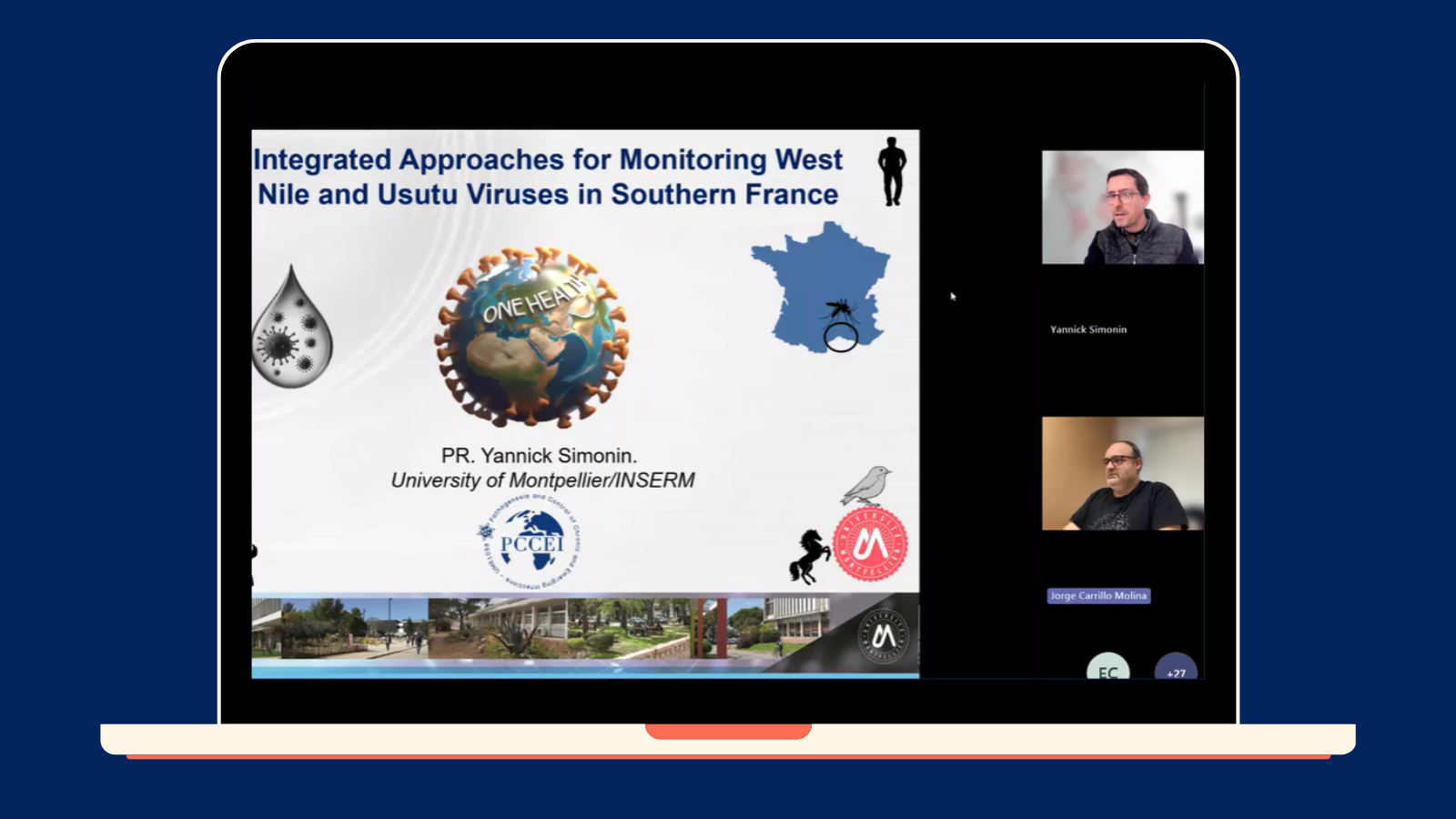
In our latest webinar, Dr. Yannick Simonin talked about how his team tracks the spread of two viruses by mosquitoes in southern France: West Nile virus and Usutu virus.
These viruses mostly circulate quietly between birds and mosquitoes. Humans and other animals can sometimes get infected too, and in rare cases the infection can affect the brain and nervous system. West Nile virus has been present in Europe for many years. Usutu virus, which was once mainly found in Africa, has been spreading more widely across Europe since the early 2000s.
Dr. Simonin presented results from a project that brings together experts in human health, animal health, virology, and environmental science. The idea is to understand these viruses by taking the whole picture: animals, people, mosquitoes, and the environment. Mosquito monitoring showed that both West Nile and Usutu viruses are now endemic in southern France, especially around Montpellier and the Camargue. Results show that several versions of these viruses are coexisting and evolving in the region.
What about birds and other animals?
Birds play a key role in spreading these viruses. Monitoring showed that Usutu virus has spread widely among local bird populations, and West Nile virus activity started early in the season. Some common species, like blackbirds and sparrows, are particularly vulnerable.
The team also works with zoos. They detected repeated Usutu infections in animals such as rheas. These findings remind us that these viruses don’t just affect humans, many animal species can be involved.
What are the key findings in humans?
Most people infected with these viruses don’t feel sick. In fact, screening of blood donors showed that the viruses were circulating “silently” in the population.
The team also identified France’s first confirmed human case of Usutu virus in a patient with neurological symptoms. They discovered that people who develop severe disease may have specific immune system characteristics, including antibodies that interfere with important antiviral defenses; type I interferons.
In laboratory studies using mice, researchers found that one particular strain of Usutu virus caused more severe disease and affected the brain more aggressively than other strains. They linked this higher severity to a small mutation in one of the virus’s key proteins.
The environment as an early warning system
The team also tested wetland water and detected viral genetic material very early in the mosquito season. This suggests that environmental monitoring could help provide an early warning before human or animal cases appear.
Why this matters
Simonin highlighted the importance of a “One Health” approach, recognizing that human health, animal health, and the environment are deeply connected.
By combining data from mosquitoes, birds, animals, humans, and ecosystems, researchers can detect outbreaks earlier, understand how these viruses persist, and better prepare for future risks.

